Faith
Where Halloween Really Comes From
Hey y’all, it’s Halloween, so let’s do something different today.
A few days ago I shared why our house sits this night out. Today I want to walk through the history, because most of us grew up with Halloween and never once heard where it came from.
It starts about 2,000 years ago in Ireland, with a people called the Celts, the tribes of Ireland, Scotland, and Britain back then. Their big fall festival was called Samhain. You say it SAH win, and the name means summer’s end. It fell right around November 1, when the harvest was in and folks got ready for the dark, cold half of the year.
The Celts believed that on that night, the wall between our world and the spirit world got thin. The dead could come back and visit their old homes. Fairies and spirits, what they called the Aos Si, could cross over too. Some of those visitors were family and got welcomed. Some were feared, and folks left food and drink out for the ones passing by.
Now I want to be straight with you, because a lot of what’s passed around online goes past what anybody can prove. The Celts didn’t write much of this down. Most of what we have was written down much later. One historian, Nicholas Rogers, puts it plain: there’s no hard proof Samhain was a festival for the dead. The time, the place, and the fear tied to that night are real.
Folks lit big bonfires on the hilltops that time of year. The stories say the fires scared off evil spirits, and families carried the flame home to relight their own fire. Costumes came out of that same world. If spirits are walking around, a disguise makes sense. By the 1500s, Scotland and Ireland had a custom called guising. Folks went house to house in disguise, sang a song or said a verse at each door, and got food for their trouble.
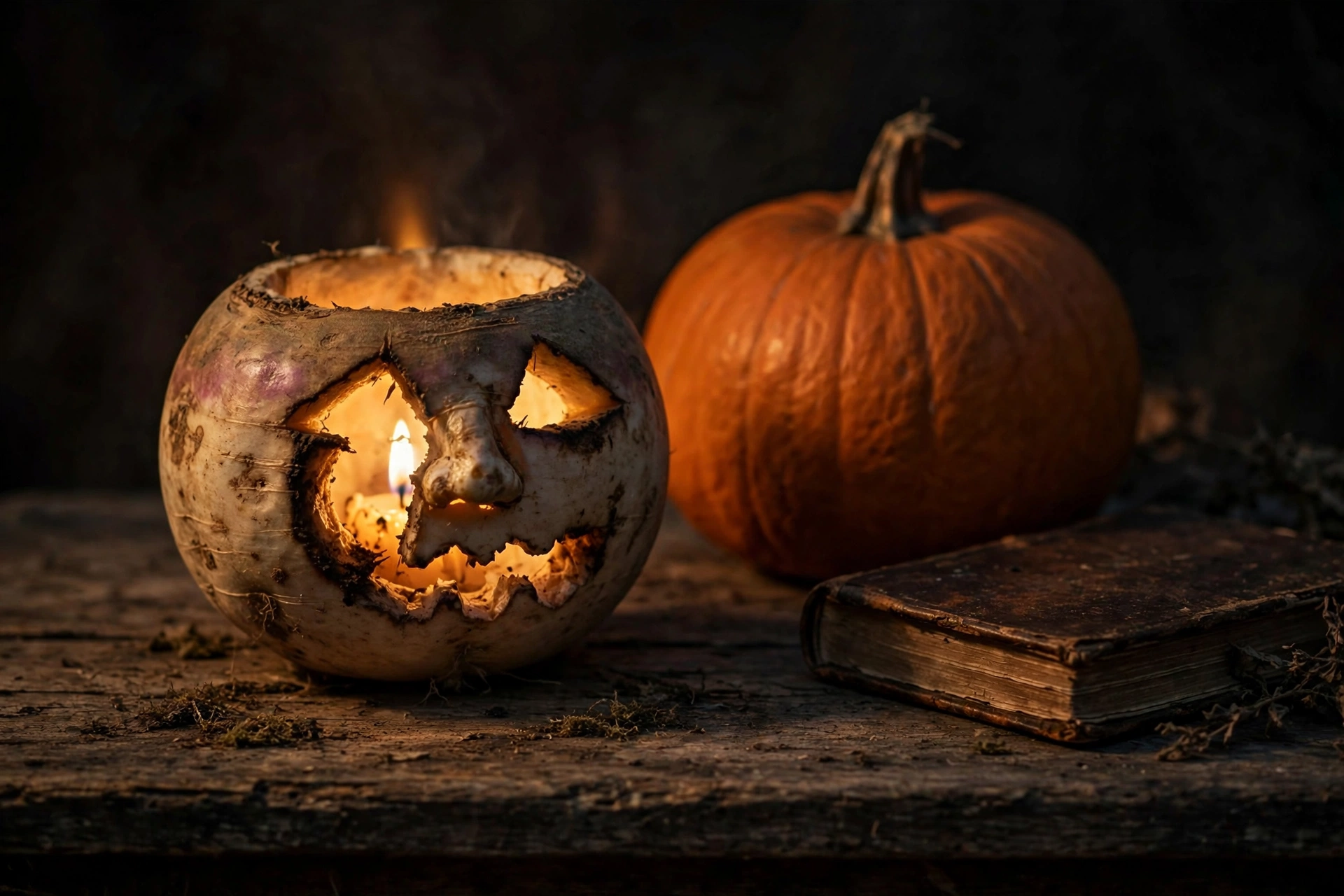
The jack o lantern didn’t start as a pumpkin either. In Ireland and Britain, folks hollowed out turnips. They carved a face, sat a candle inside, and carried it as a lantern. The name comes from an old Irish story about Stingy Jack, who tricked the devil and ended up shut out of heaven and hell both, wandering the dark with a burning coal inside a turnip. Jack of the lantern. In America, pumpkins were bigger and easier to carve, and they took the turnip’s job for good.
All this time, the church calendar was landing on the very same days, and this is where the name Halloween comes from. The church set aside November 1 to honor all the saints. It was kept in May at first, and in the 800s it moved to November 1. Some say the church put it there to take the place of the pagan festival. Others say the date came about on its own, and the history folks still argue about it.
The night before a holy day was called its eve, so October 31 became All Hallows Eve, because a hallow is a saint. Say it fast for a few hundred years and you get Halloween. November 2 became All Souls Day, a day to pray for regular folks who had died, not just the saints. Put the three days together and folks called it Allhallowtide.
And the two worlds didn’t stay in their own lanes. Same towns, same families, same dates. Church prayers for the dead sat right next to bonfires and disguises, and old habits kept mixing in.
That mix gave us trick or treat. Around All Souls Day, poor folks in England went door to door souling. They’d pray for the family’s dead, and in return they’d get a soul cake, a small round spiced cake. Kids took the job over in time. In Scotland and Ireland, guisers were already knocking in costume, singing for fruit and nuts. Put the two together and there’s trick or treat being born. Costume on, knock, get your food.
Halloween came to America with the immigrants. The early colonists wanted nothing to do with it. But in the 1800s, Irish and Scottish families crossed the ocean in a flood, a lot of them running from the potato famine, and they brought the night with them. Here it turned into harvest parties, ghost stories, and a whole lot of pranks, and towns pushed treats and parties to calm the pranks down.
The trick or treat we know is younger than folks think. The words show up in print in the 1920s. Sugar rationing in the war slowed it down, then it took off in the 1950s, in the new suburbs. The candy companies made small wrapped candies just for the night, and by the 1970s wrapped candy was the standard handout because parents didn’t trust anything unwrapped. And here we are, with a night that moves billions of dollars every year.
So look at the road it traveled. It starts with a night when folks believed the dead walked and spirits crossed over. The church puts its days for remembering the dead on the same spot on the calendar, and the folk customs mix in and won’t let go. Then America takes it, sweetens it, and sells it back to us in a plastic bucket. The candy is new paint on a very old night.
Paul said it plain in 1 Corinthians 10:21, “Ye cannot drink the cup of the Lord, and the cup of demons: ye cannot be partakers of the Lord’s table, and of the table of demons.”
I’m not sharing this to look down on anybody. Plenty of good folks never heard this history, and I didn’t either for a long time. But we ought to know what a thing is before we hand it to our kids. Now you know where it came from. What you do with that is between you and God.
God bless y’all, see you later, John